
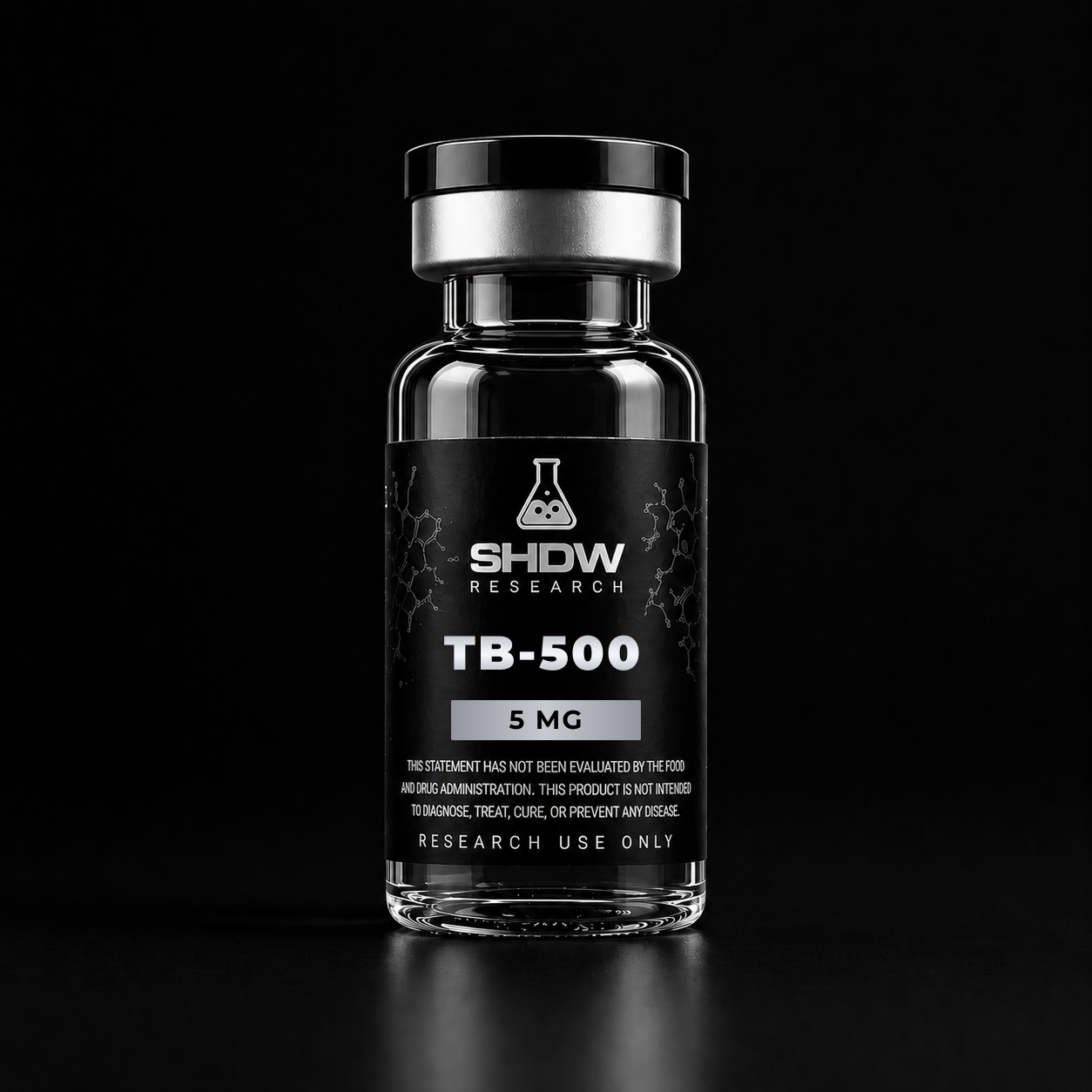
TB-500
Original price was: $49.99.$34.99Current price is: $34.99.
TB-500 is a synthetic peptide modeled after a functional region of thymosin beta-4, consisting of 43 amino acids. It is studied for its role in tissue remodeling, cellular migration, and actin regulation. In vitro research focuses on TB-500’s effects on angiogenesis, inflammatory response modulation, and wound repair signaling. The peptide is of particular interest in models involving epithelial and connective tissue dynamics due to its influence on cytoskeletal reorganization and cell motility.
For laboratory research use only. Not for human or veterinary use.
Certificate of Analysis
Batch documentation is available for every compound so you can verify identity and purity.
≥99% Purity Standard
Every compound is held to a ≥99% purity standard before it reaches the catalog.
Shipping & Handling
Orders are processed within 1–2 business days and shipped via USPS Priority Mail.
Research Use Only
Strictly for in vitro research and laboratory use. Not for human or veterinary consumption.
Description
TB-500 is a synthetic research peptide modeled after a functional region of thymosin beta-4, a naturally occurring protein involved in cellular organization, tissue remodeling, and repair-related signaling. TB-500 consists of 43 amino acids and is widely studied in laboratory environments for its potential role in cell migration, actin regulation, angiogenesis, and tissue-response mechanisms. Because thymosin beta-4 is closely associated with cytoskeletal activity, TB-500 is often used as a reference peptide in studies focused on how cells move, reorganize, and respond to structural stress under controlled experimental conditions.
One of the major research interests surrounding TB-500 is its relationship with actin regulation. Actin is a key structural protein involved in maintaining cell shape, supporting movement, and enabling cellular repair responses. In vitro studies frequently examine how TB-500 may influence actin dynamics, cytoskeletal reorganization, and cell motility. These pathways are especially important in models involving epithelial cells, connective tissue cells, and other systems where migration and structural adaptation are central to repair processes.
TB-500 is also commonly studied for its role in angiogenesis and tissue remodeling. Angiogenesis, the formation of new blood vessels, is an important part of tissue maintenance and recovery-related biological activity. Researchers may evaluate TB-500 in experimental models to better understand how peptide signaling may influence vascular-supportive pathways, cellular movement, and extracellular matrix remodeling. These areas of study make TB-500 relevant in research involving soft tissue response, wound-repair signaling, and regenerative biology.
Another area of TB-500 research involves inflammatory response modulation. In controlled laboratory settings, researchers may examine how TB-500 interacts with signaling pathways associated with cellular stress, tissue damage response, and inflammation-related activity. These investigations help support a deeper understanding of how thymosin beta-4–related peptides may contribute to tissue adaptation, repair signaling, and cellular communication.
Due to its defined amino acid sequence, connection to thymosin beta-4 research, and relevance to cell movement and tissue remodeling, TB-500 remains an important research peptide in studies focused on actin regulation, angiogenesis, wound-repair signaling, inflammatory response pathways, epithelial dynamics, and connective tissue biology. Its use in controlled experimental environments supports broader investigation into peptide-mediated repair mechanisms and cellular regeneration pathways.
These statements have not been evaluated by the Food and Drug Administration. This product is not intended to diagnose, treat, cure, or prevent any disease. Not for human consumption.
TB-500 is supplied by SHDW Research (also known as Shadow Research) as a research-use-only laboratory compound intended strictly for in vitro scientific study.
About TB-500 Research Compound
Laboratory buyers choose this material when they need clear research-use boundaries, consistent handling guidance, and a U.S.-based supplier workflow.
This listing is positioned for controlled laboratory purchasing — not consumer supplementation or human use.
TB-500 Quality Standards
SHDW Research targets a ≥99% purity standard with third-party testing support. Certificates of Analysis (COAs) may be available upon request — see our COA & testing standards page.
How to Order This Compound
Add the product to your cart, complete checkout, and follow the invoice payment instructions. Tracking is emailed after payment confirmation.
Browse the SHDW Research shop, explore the research hub, review our FAQ, read About SHDW Research, check the shipping policy, or contact support.
For independent compound reference data, see the PubChem compound database.
TB-500 is for research use only. Not for human or veterinary consumption.
Related products
-
 PEPTIDES
MT1
$49.99 Add to cart -
Sale!
 PEPTIDES
NAD+
Original price was: $79.99.$69.99Current price is: $69.99. Add to cart -
 PEPTIDES
PT-141
$39.99 Add to cart -
Sale!
 PEPTIDES
GLP3 Reta
Price range: $74.99 through $199.99 Select options This product has multiple variants. The options may be chosen on the product page
Reviews
There are no reviews yet.